

Turning governance intent
into system behaviour
Policy controls and governance frameworks are defined by governance and compliance teams.
These teams do not control how systems behave. Yet they remain accountable for outcomes.
This is where the inevitable question arises.
How is that policy and regulatory intent reflected in real system behaviour?
We work with governance and compliance teams to close this gap, first through advisory work that identifies where policy and regulatory intent needs to be applied within the system.
This results in a clear, structured report that maps responsibilities and policies to the specific points in the system where control is required.
From there, we translate this into concrete software changes, implementing the control layer that governs how decisions are made in production.
This allows commitments to be applied consistently at the points where decisions are made.
We also produce concrete evidence that supports assurance work, audits, and regulator conversations.
The approach is model agnostic and applies across prompts, agents and workflows.
Enforcing governance where AI decisions happen
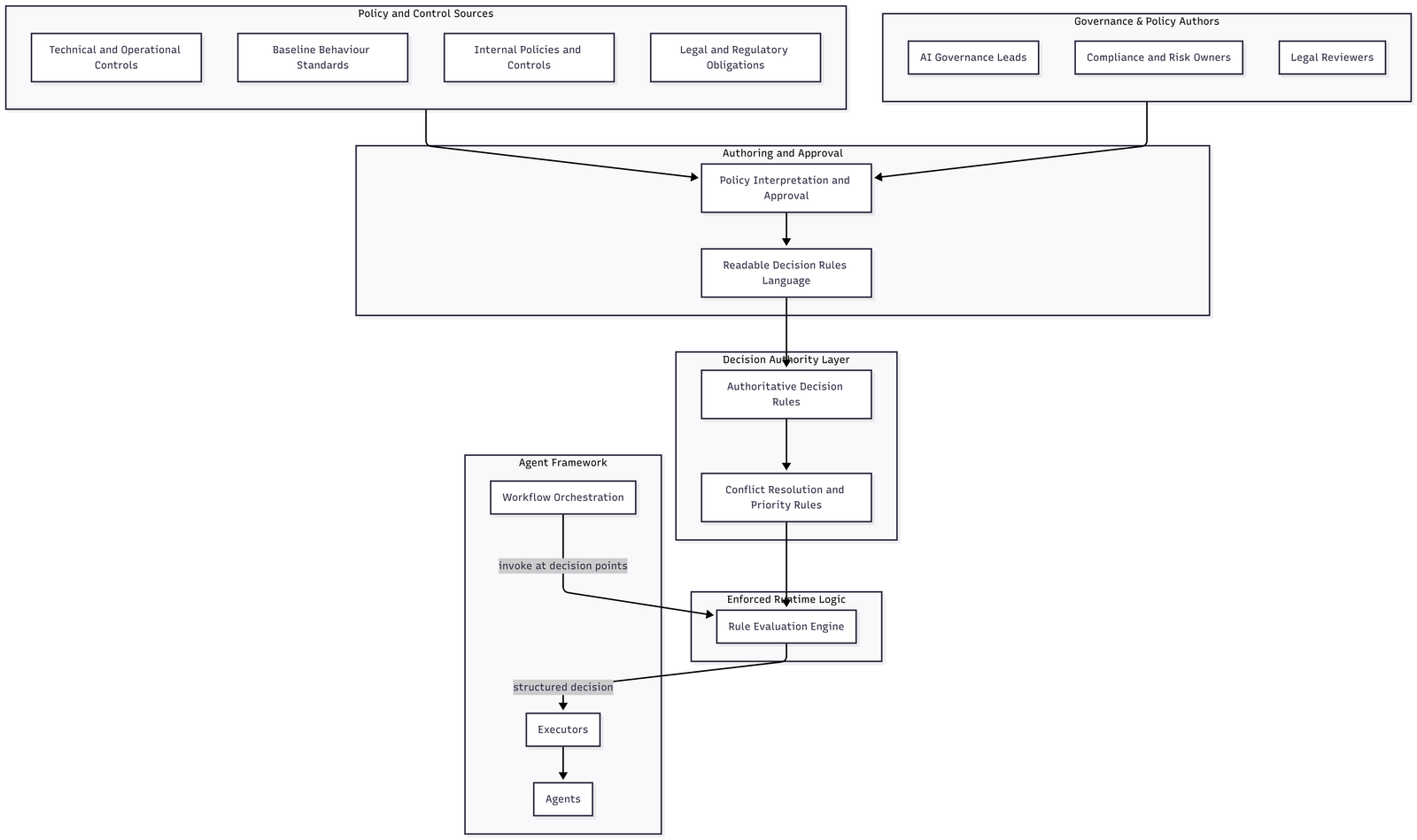
The diagram below shows a real production pattern used in regulated environments to enforce governance over AI systems.
It illustrates how policy, controls and legal obligations are translated into enforceable decisions at defined points in a system, independent of models, prompts or agents.
Governance intent is interpreted and approved by accountable owners, then expressed as explicit decision rules with clear resolution semantics. These rules govern how AI is allowed to act within the system.
Rules are defined outside application code and models.
They can combine structural checks, classifier signals, contextual constraints and domain logic. This allows behaviour to be changed without redeploying systems or rewriting prompts.
The key idea is separation of responsibility.
AI models generate output.
Decisions about whether, how and under what conditions AI may act are enforced elsewhere, with traceability and evidence by design.
This architecture is implemented in ARCS, our decision control platform for enforcing governance in AI systems.
Patented Decision Control Systems in Regulated Environments
These patents represent work on rules and control based decision systems in regulated, high trust environments, where behaviour must be explicit, auditable and changeable without redeploying core systems.
Patent no: US11651241B2
Title: System and Method for Specifying Rules for Operational Systems
Status: Granted
A rules architecture that separates decision logic from operational application code.
Rules are defined, versioned, and executed deterministically against live system data at runtime.
This enables controlled change in production systems with explicit decision ownership and full auditability.
Click to see the patent
Patent no: US20180349426A1
Title: Multi Network Systems and Methods for Providing Current Biographical Data of a User to Trusted Parties
Status: Granted
A policy governed data synchronisation system for sharing identity information across multiple organisations.
Rules control how, when, and where biographical data updates are propagated to trusted parties.
This ensures consistency, traceability, and controlled disclosure across network boundaries.
Click to see the patent
Patent no: US20180260872A1
Title: Systems and Methods for Use in Initiating Payment Account Transactions to Acquirers
Status: Granted
A policy controlled transaction initiation framework for autonomous and connected devices.
Device generated events are evaluated against predefined rules before initiating payment authorisation flows.
The rules define limits, approvals, and execution paths, enabling controlled machine initiated transactions.
Click to see the patent
Patent no: EP3531358A1
Title: Reducing Fraudulent Data Transfers
Status: Granted
A context aware security model that controls how sensitive data is transferred based on detected user intent and environment signals.
Runtime policies determine whether data transfers are allowed, restricted, or modified without changing application code.
This enables explicit, auditable control over data movement while reducing fraud risk.
Click to see the patent
Our Services
AI Governance Enforcement Review
Governance Enforcement Integration
Policy to Decision Rules Mapping
About Us
Yaseen Ali
Discuss governance enforcement
If you are running AI in production and behaviour is hard to explain, govern, or change safely, outline the situation below.