

Bring AI behaviour under explicit control
Make AI predictable and reviewable in production
Welcome to
Pixels & Crowd
AI systems do not behave consistently.
The same input can produce different decisions and different outcomes.
In production systems, that variability becomes risk.
Most teams try to manage this with prompts, agents and review workflows.
Behaviour spreads across the system.
Every change carries unknown risk.
Control erodes over time.
We work with organisations that need AI behaviour to be deterministic at the system level, even when models are not.
We introduce a decision layer around AI so behaviour can be controlled, changed and reasoned about without destabilising production.
Rules live outside application code.
Policies change without redeployments.
System behaviour becomes predictable again.
If AI is already in production and behaviour matters, we should talk.
Deterministic behaviour around AI
AI models are probabilistic by design. Production systems are not.
Trying to control behaviour through prompts, agents or workflows spreads logic across the system.
The correct abstraction is a decision layer.
A decision layer sits outside models and application code. It defines how decisions are evaluated, constrained, routed, overridden or deferred depending on context.
Behaviour can change without redeployments.
This is how AI becomes controllable in production.
Below is one example of how this is implemented in practice.
How we control AI behaviour before execution
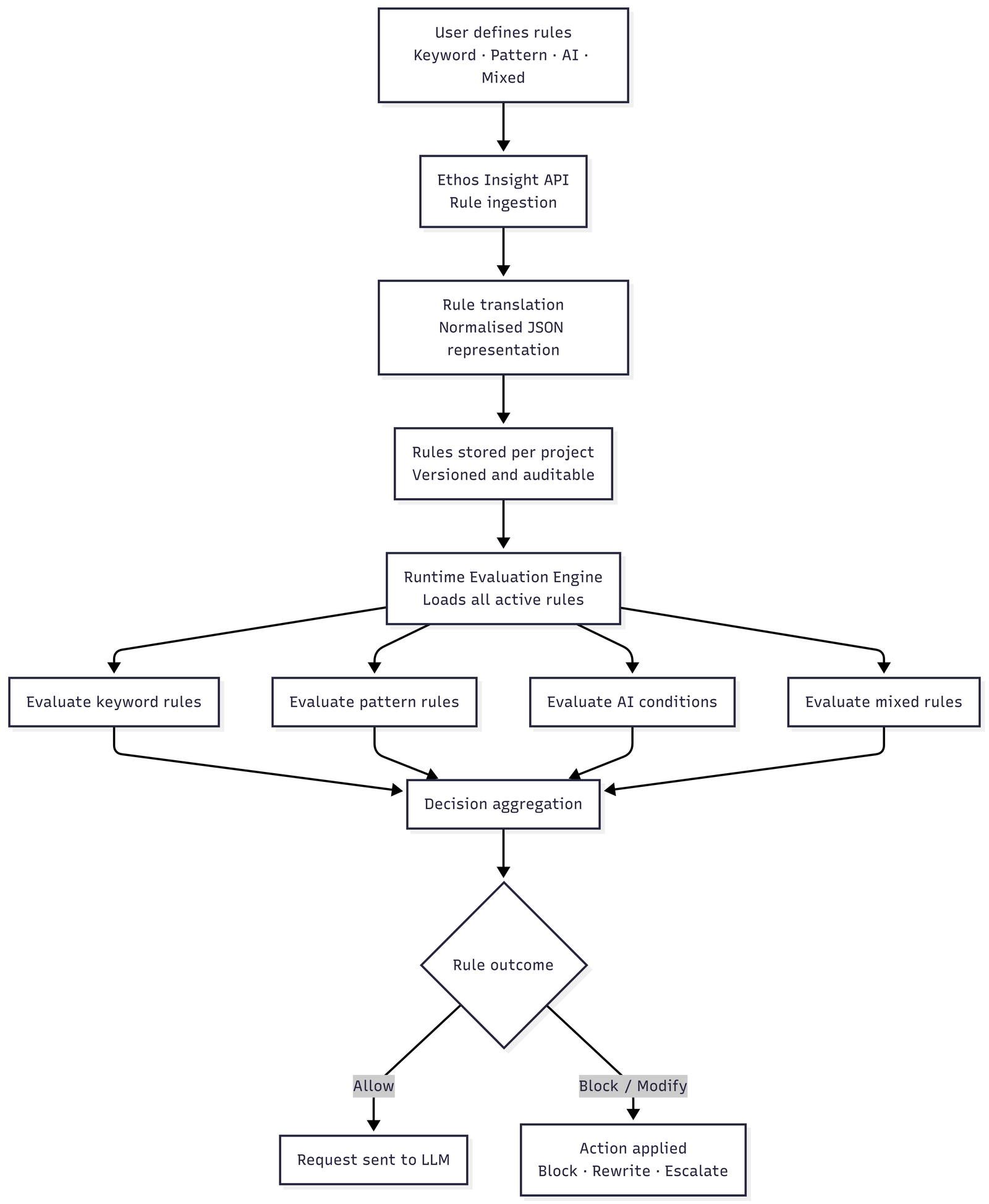
This diagram below shows a real production pattern used in Ethos Insider API, built at Ethos Agentics.
This is one of several established rule based control patterns, chosen here to illustrate how behaviour can be governed at runtime. Other patterns apply rules before, during, or after model execution depending on risk, latency and control requirements.
It represents a decision layer that governs how AI is allowed to act within a system. In this example, decisions are evaluated before a prompt is sent to a model.
Rules are defined independently of application code and models. They can combine keyword checks, structural patterns, classifier signals and mixed logic. This allows behaviour to be changed without redeploying systems or rewriting prompts.
The key idea is separation. AI models generate output. Decisions about whether, how and when they are allowed to act are handled elsewhere.
Patented Decision Control Systems in Regulated Environments
These patents represent work on rules and control based decision systems in regulated, high trust environments, where behaviour must be explicit, auditable and changeable without redeploying core systems.
Patent no: US11651241B2
Title: System and Method for Specifying Rules for Operational Systems
Status: Granted
A rules architecture that separates decision logic from operational application code.
Rules are defined, versioned, and executed deterministically against live system data at runtime.
This enables controlled change in production systems with explicit decision ownership and full auditability.
Click to see the patent
Patent no: US20180349426A1
Title: Multi Network Systems and Methods for Providing Current Biographical Data of a User to Trusted Parties
Status: Granted
A policy governed data synchronisation system for sharing identity information across multiple organisations.
Rules control how, when, and where biographical data updates are propagated to trusted parties.
This ensures consistency, traceability, and controlled disclosure across network boundaries.
Click to see the patent
Patent no: US20180260872A1
Title: Systems and Methods for Use in Initiating Payment Account Transactions to Acquirers
Status: Granted
A policy controlled transaction initiation framework for autonomous and connected devices.
Device generated events are evaluated against predefined rules before initiating payment authorisation flows.
The rules define limits, approvals, and execution paths, enabling controlled machine initiated transactions.
Click to see the patent
Patent no: EP3531358A1
Title: Reducing Fraudulent Data Transfers
Status: Granted
A context aware security model that controls how sensitive data is transferred based on detected user intent and environment signals.
Runtime policies determine whether data transfers are allowed, restricted, or modified without changing application code.
This enables explicit, auditable control over data movement while reducing fraud risk.
Click to see the patent
Our Services
AI Decision Risk Review
Rule Decision System Integration
Rules Development
About Us
Yaseen Ali
Start a Decision Review
If you are running AI in production and behaviour is hard to explain, govern, or change safely, outline the situation below.